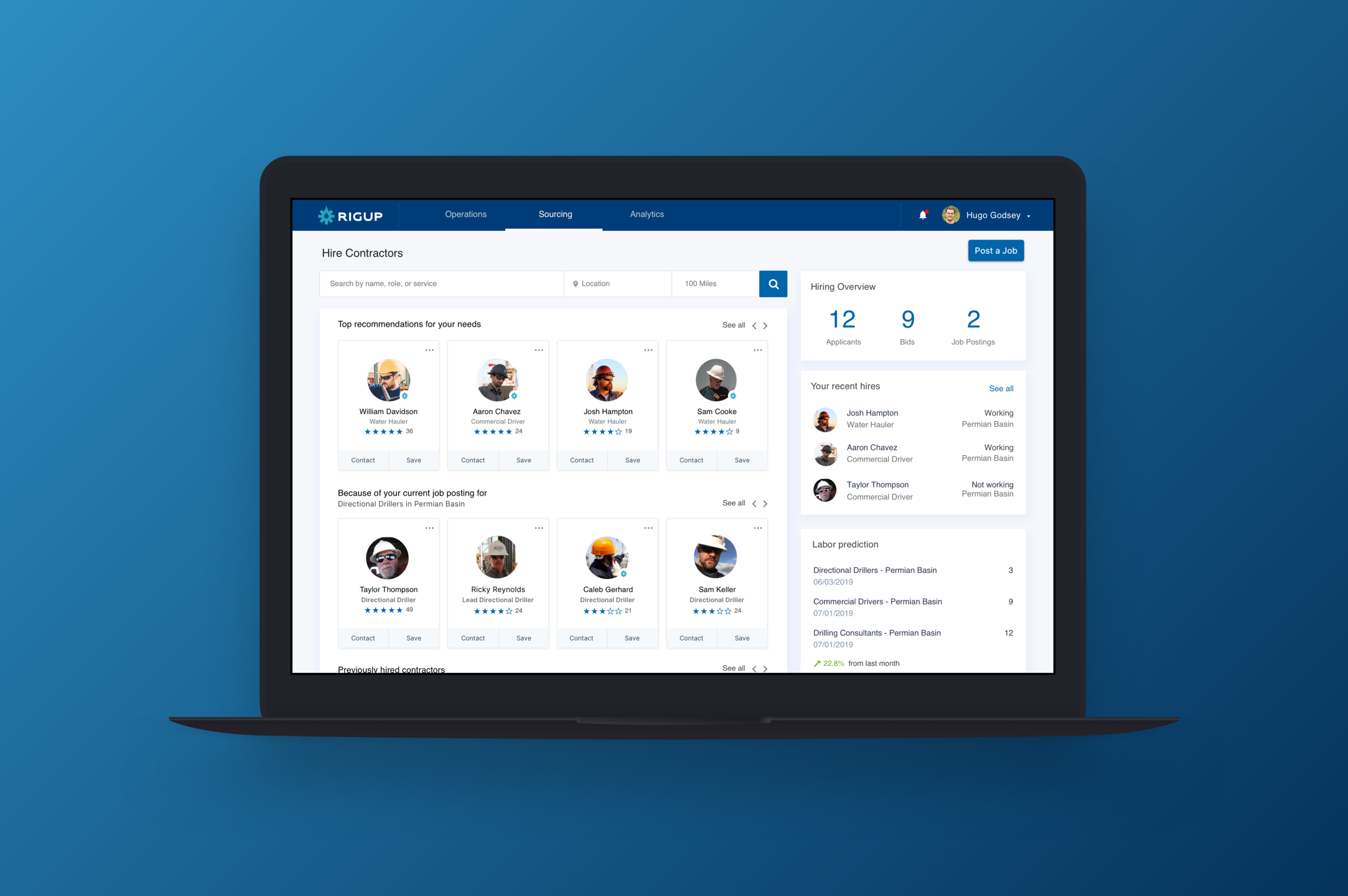
Transforming the energy industry
RigUp is an online labor marketplace that empowers the people who power the world. RigUp matches energy contractors with operators and services companies seeking to hire highly skilled labor. We’ve transformed the industry by an exponential level; This has been recognized through our latest round of funding from Andreessen Horowitz. https://a16z.com/2019/10/10/rigup/
Role
UX/UI
Research
Strategy and Planning
Design Thinking Facilitator
Team
1 Product Designer
8 Engineers
2 Product Managers
Problem
The temporary nature of oil and gas work typically has a job life-cycle that lasts anywhere from 2 weeks to 12 months. Additionally, the specialized skills required by each job type make it difficult to find and source labor quickly.
Currently, Buyers (those responsible for hiring independent contractors) lack foresight into what is coming down the pipeline in terms of labor demand. Often, job postings will be created at the last minute. RigUp’s internal Sourcing Operations team bears most of the burden in filling these talent gaps. Before the creation of an on-platform solution, they relied on a time-consuming manual process and untrustworthy contractor data.
Discovery
With the knowledge of the energy industry and the current sourcing process in oil and gas, I conducted interviews with Buyers throughout the country and RigUp’s internal Sourcing Operations team.
Our goal was to understand how our users currently hire, learn more about the problems they face, and validate assumptions.
Our process was simple: we learned as much as we could about Buyers from internal RigUp employees and third-party job marketplaces. We wanted to have a baseline of information before heading into the interviews.
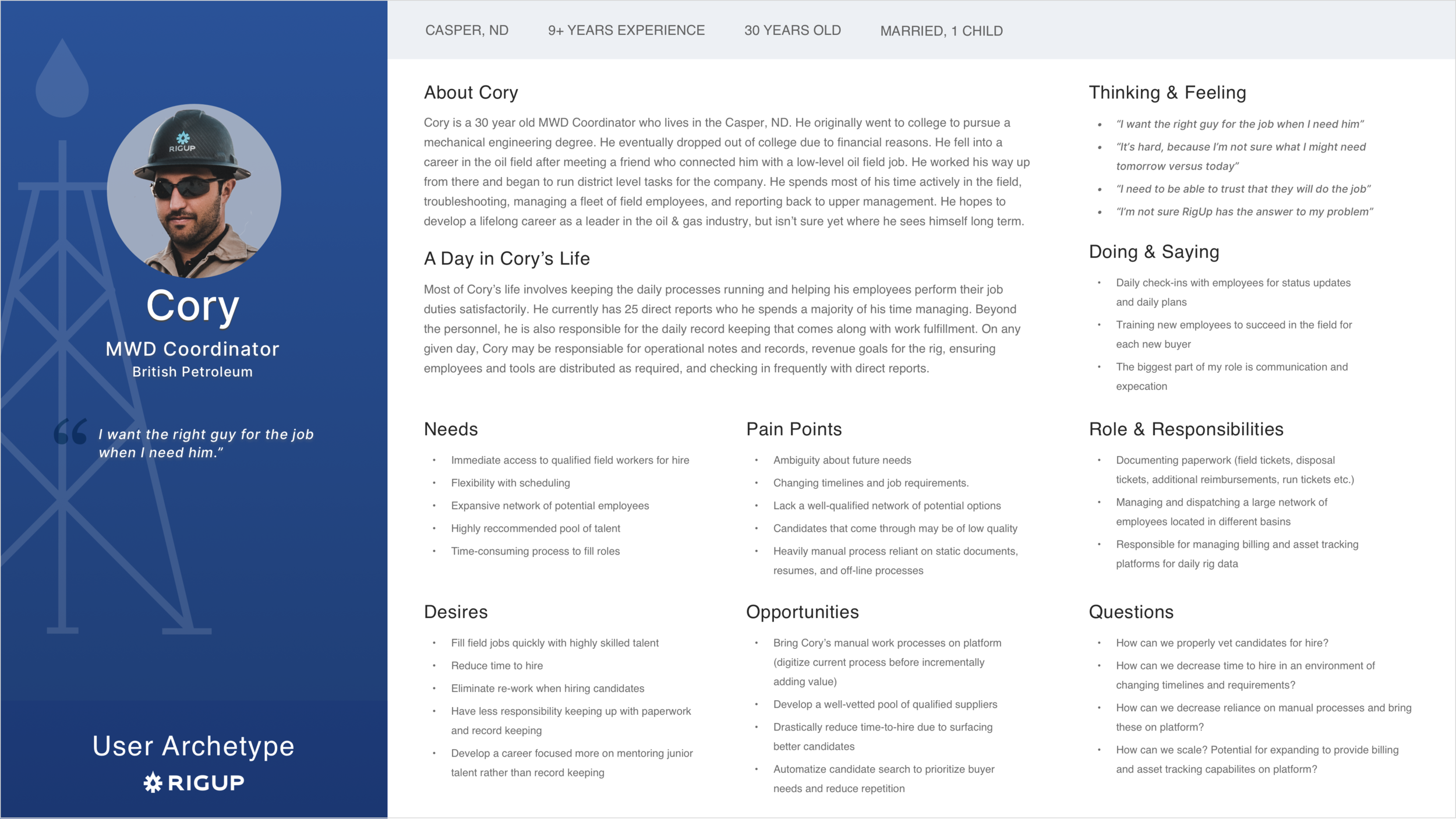
I shadowed and interviewed the Sourcing Operations team to understand their current process and problems. I developed a set of baseline questions and a research guide to learn more about the oil and gas industry hiring process. We recruited Buyers to complete on-line surveys and conducted interviews to inform our decisions. Based on the responses I received, I created personas, high-level user flows, and wireframes.
Building Empathy

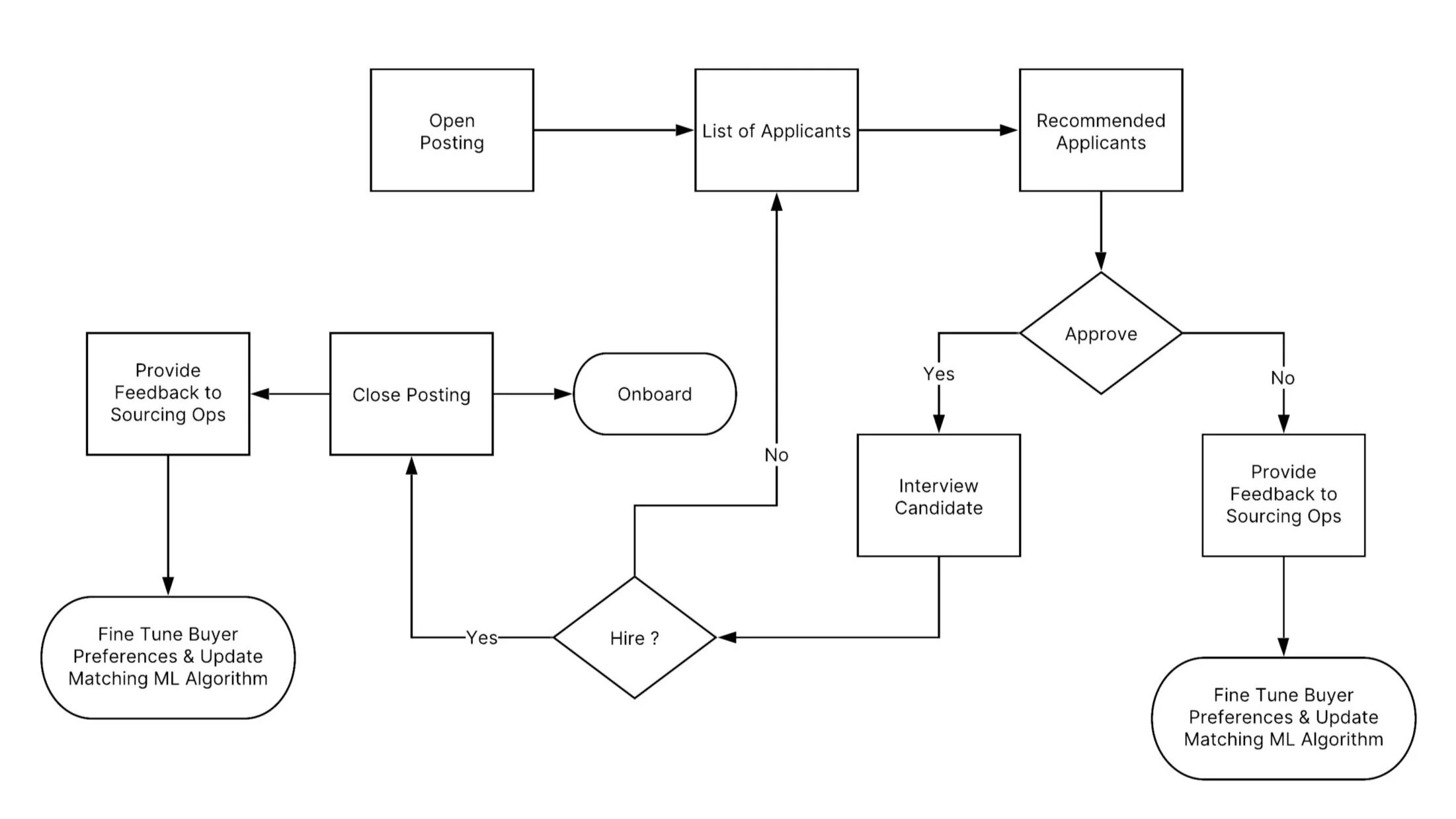
Hiring process workflows
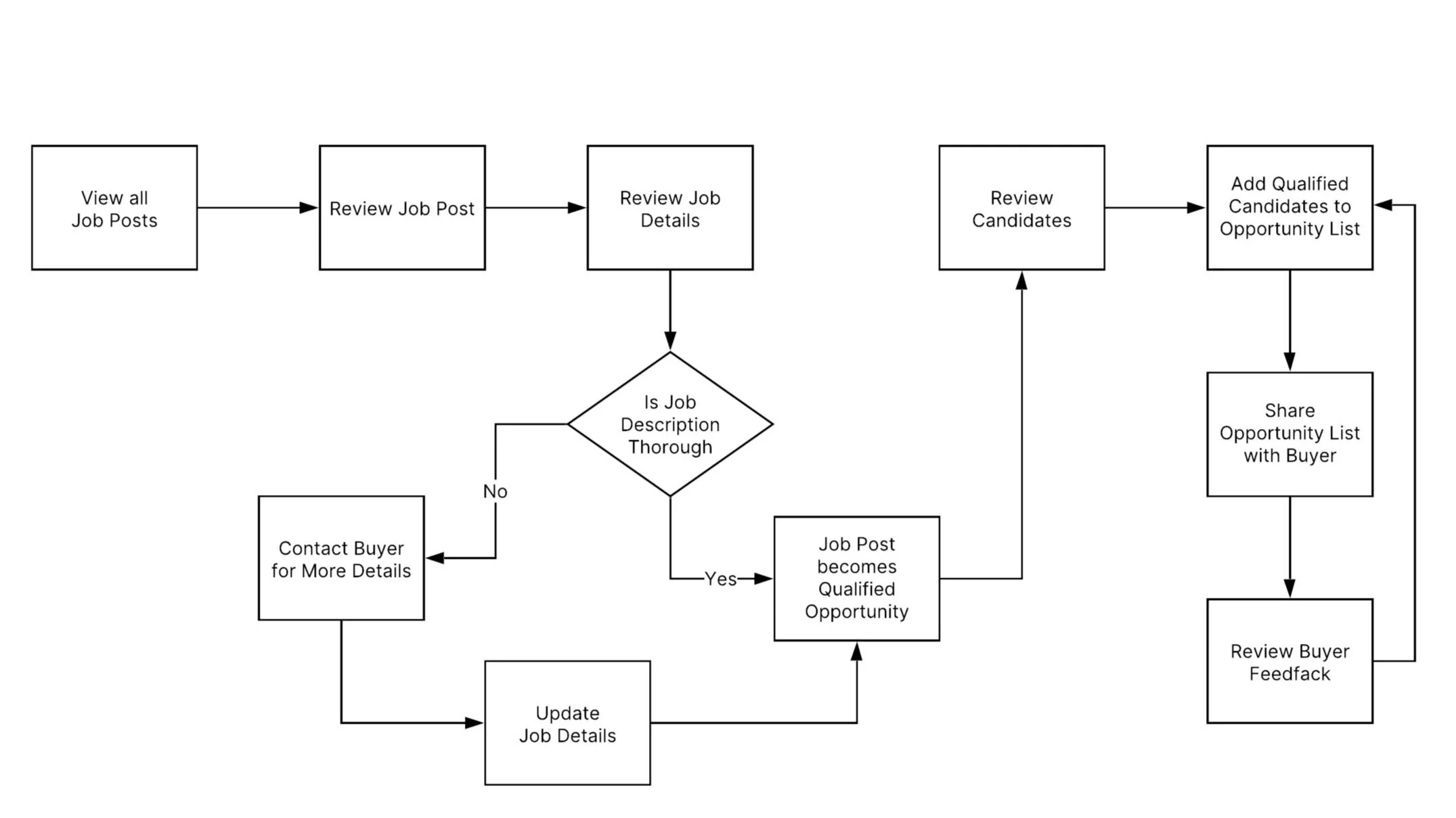
Based on user interviews and current processes, I created workflows to capture the future vision of the hiring process.
Buyer workflow - hiring
Sourcing Operations workflow - job fulfillment
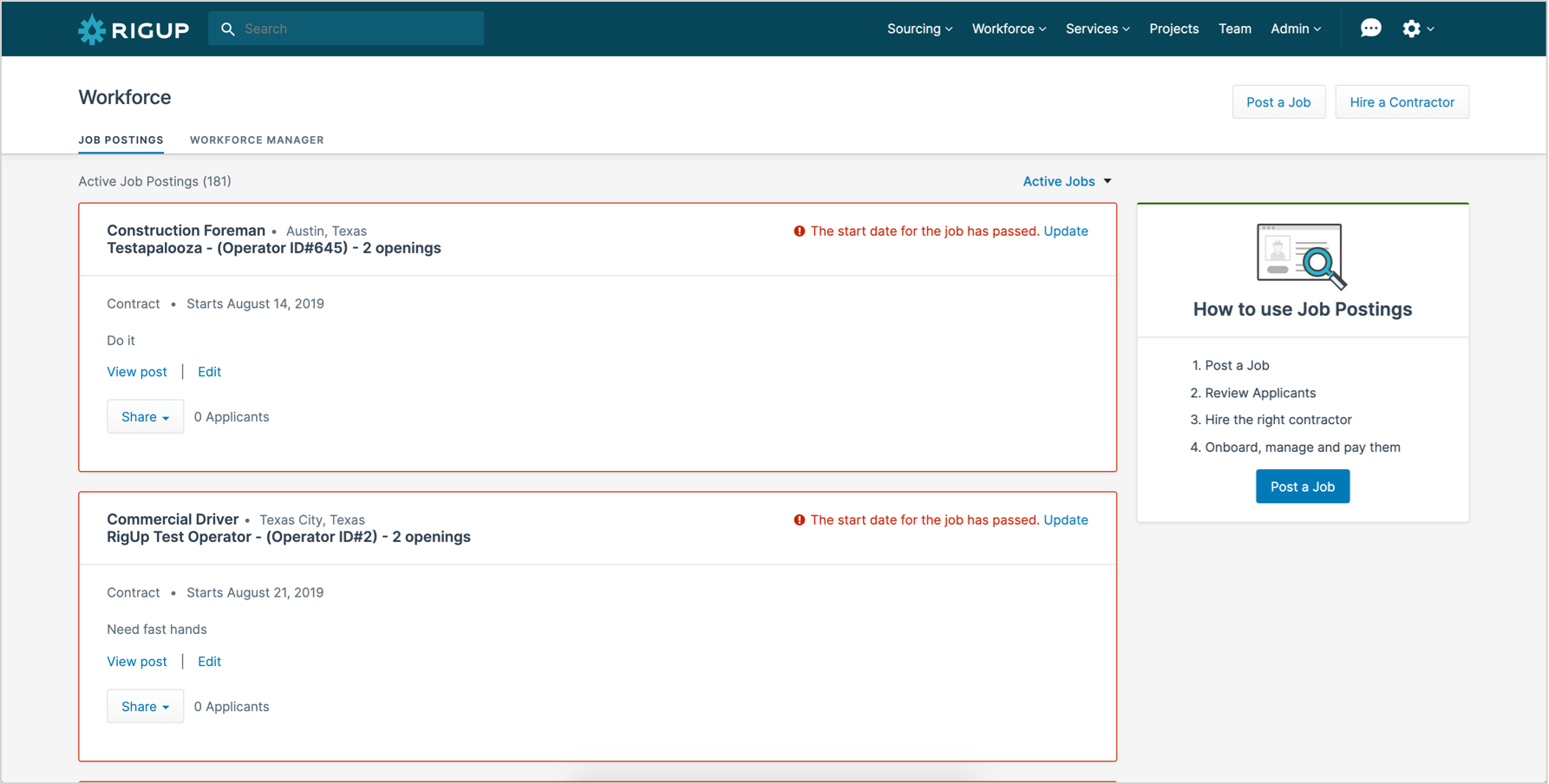
Analysis of the previous job posts page
Lack of hierarchy and essential information
The previous jobs page displays inactive job posts. They are persistent and populated at the top of the page. As a result, Sourcing Operations has to continuously wade through old posts to reach time-sensitive labor requests.
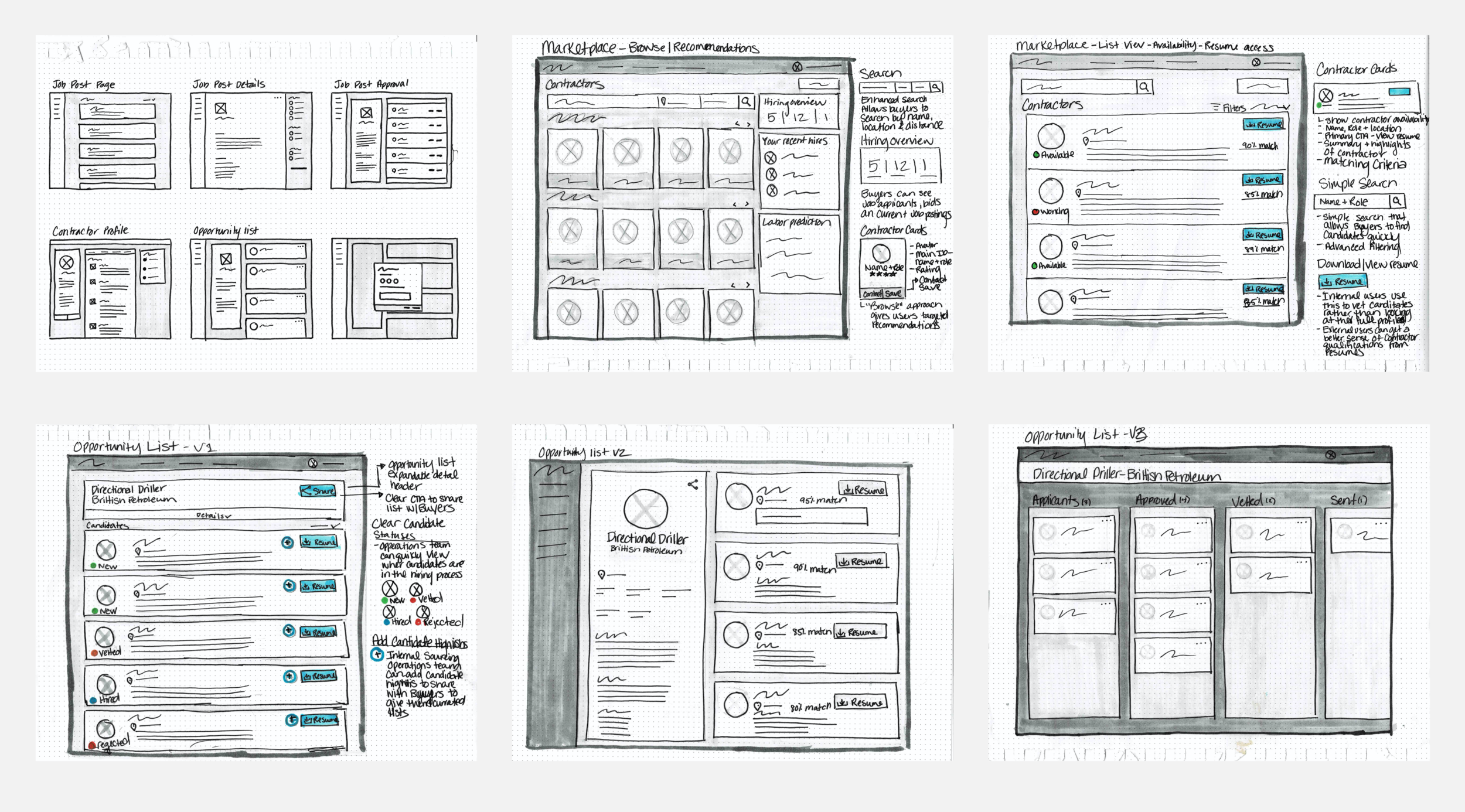
Wireframing and prototyping
With low-fidelity paper prototypes, I tested the planned workflow with Buyers and the internal Sourcing Team. Adjustments could be made before going into the much more costly digital implementation.
After some modifications, I created wireframes, and high-fidelity prototypes. Again, user tests revealed small vulnerabilities in the structure of the user interface, in some formulations and interactions. Also, the users asked smart questions, which led to further improvements.
Step-by-step workflow
• Defined all the problems the Buyer faces
• Defined all the problems that the Sourcing team faces
• Competitive analysis around job boards for baseline UX/UI
• Combined solutions to the above problem sets in a linear manner
• Simplified solutions for each step in the workflow
Solution
The solution includes both future vision work and work that has been implemented and tested. It shows the hiring process from beginning to end from the perspective of Buyers, independent contractors, and RigUp’s Sourcing Operations team.
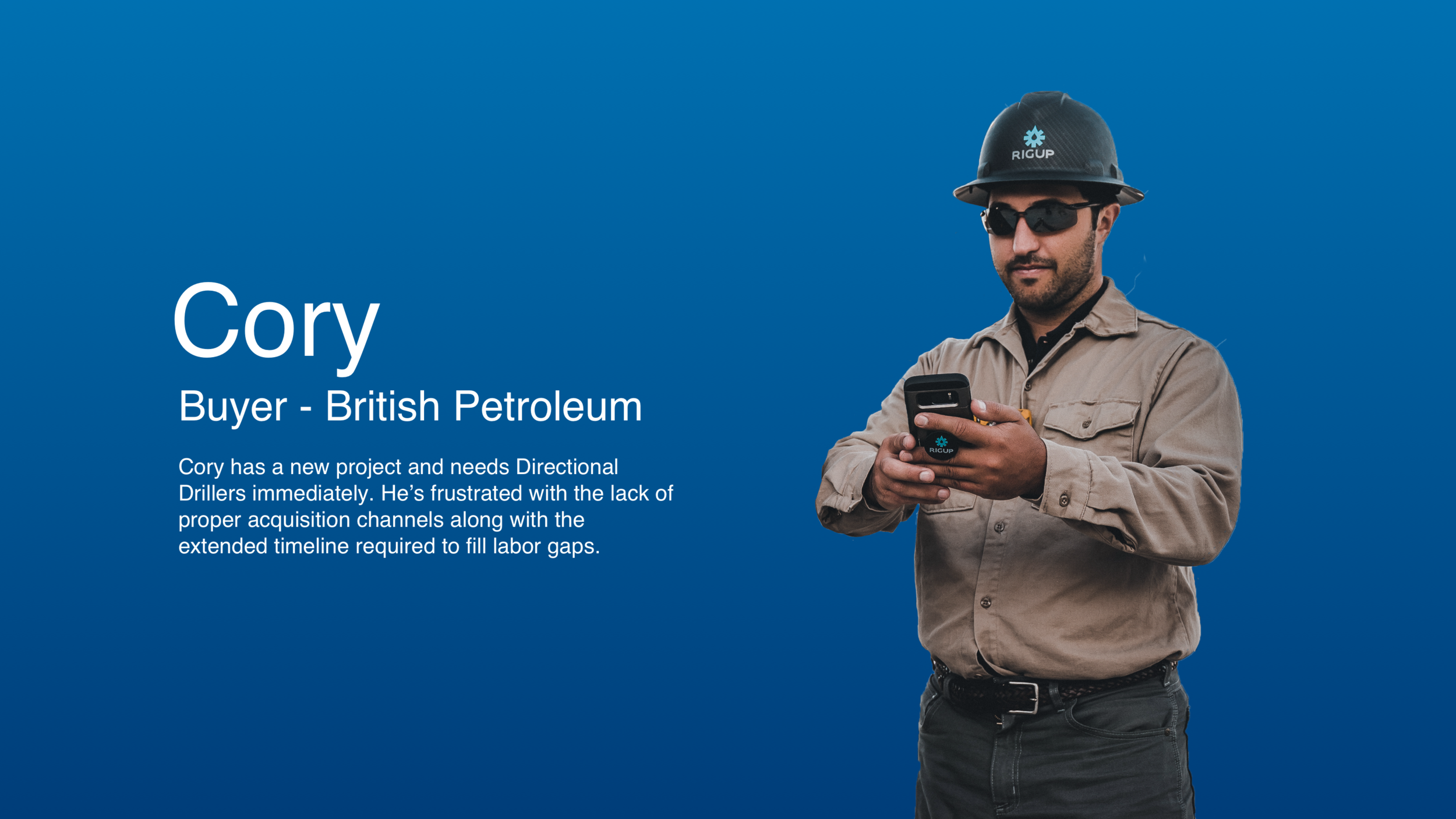
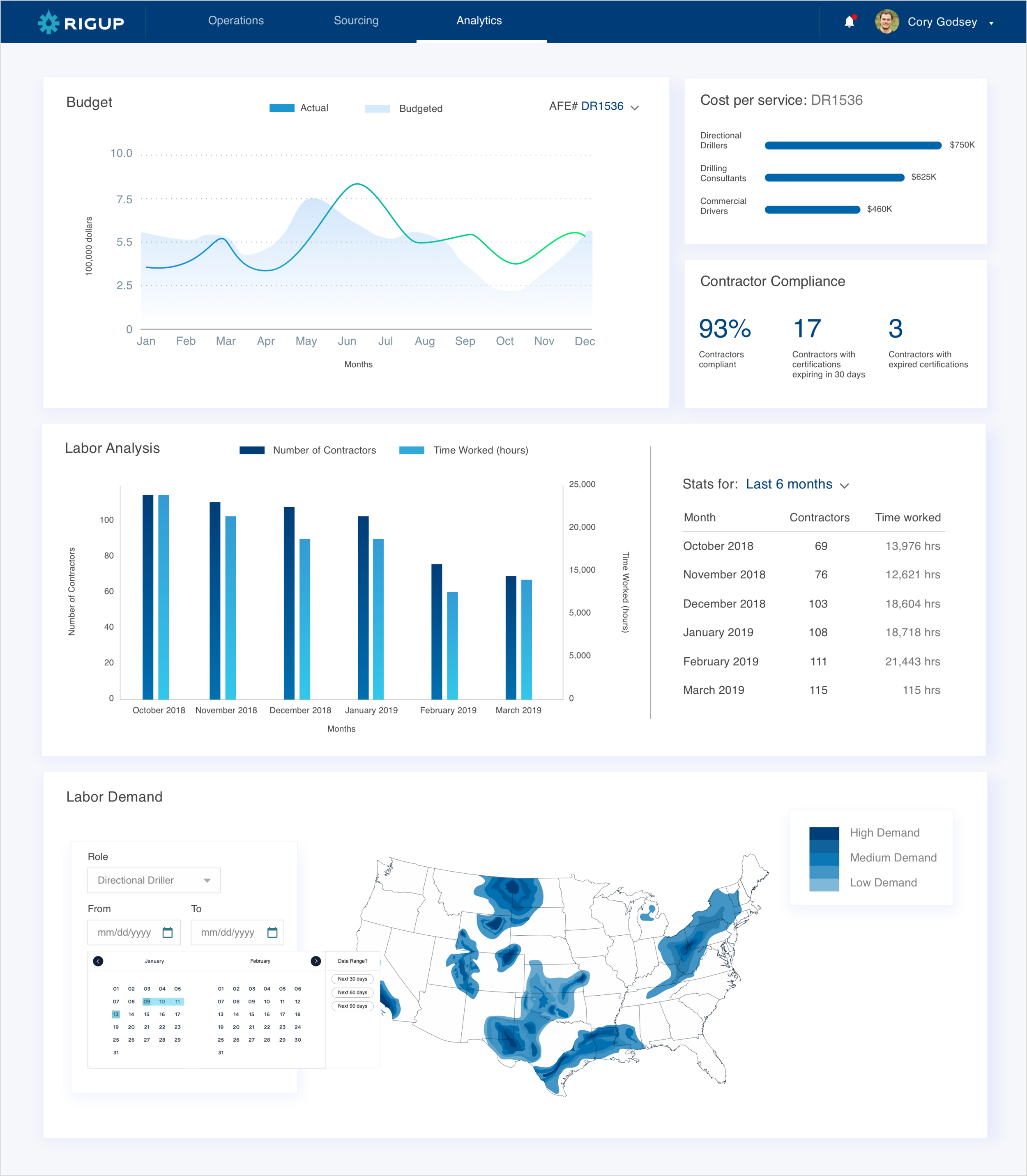
A high level overview
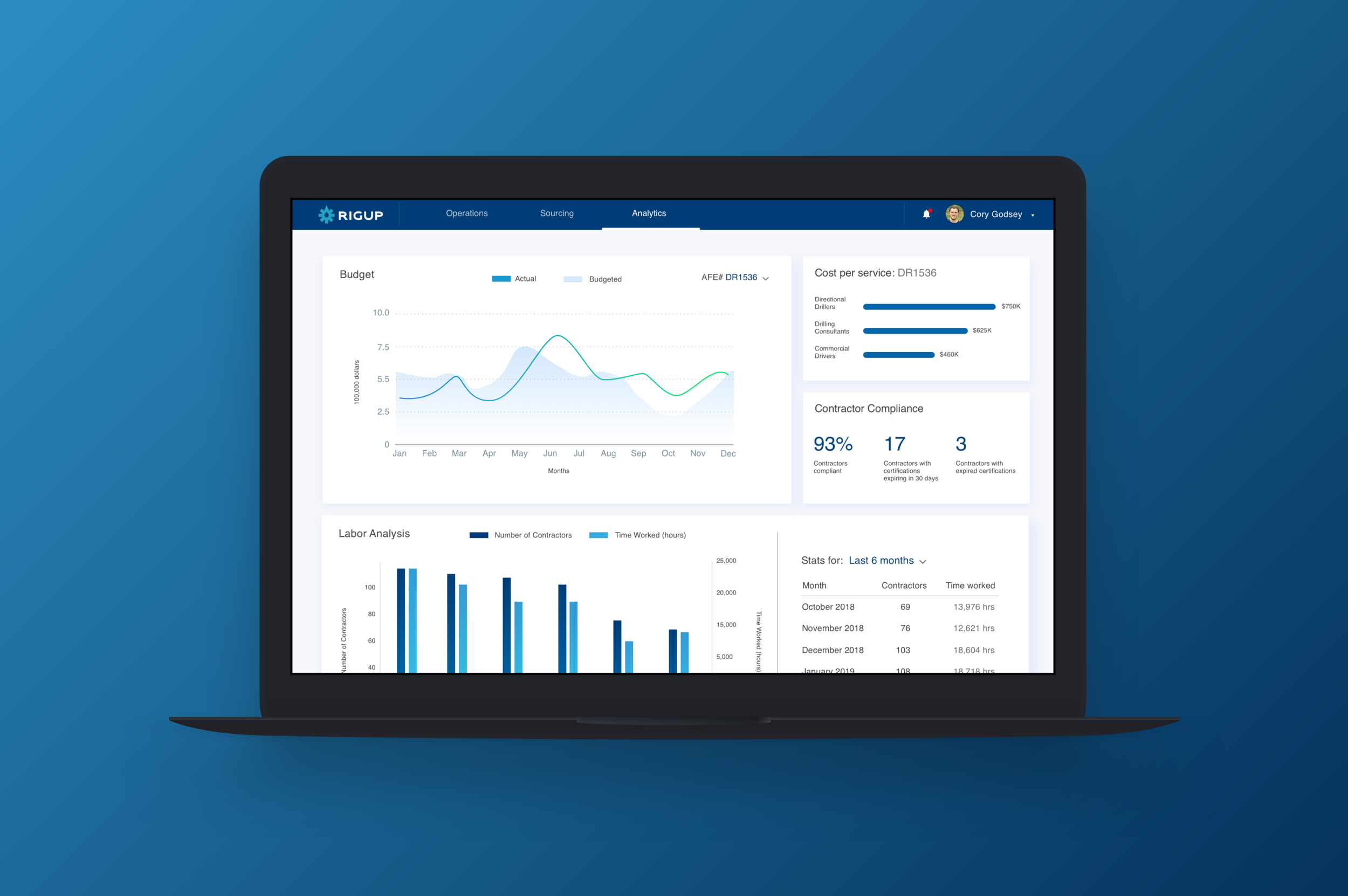
Budget assessment and marketplace financials
Cory checks his analytics dashboard to see where he currently stands with the remainder of the Directional Driller’s budget within his company and their available resources. Because he can see a high-level understanding of where the market is booming for a specific role, in this case, Directional Drillers, he can mitigate the potential labor shortage for placing a position request in earlier.
Know exactly where you stand
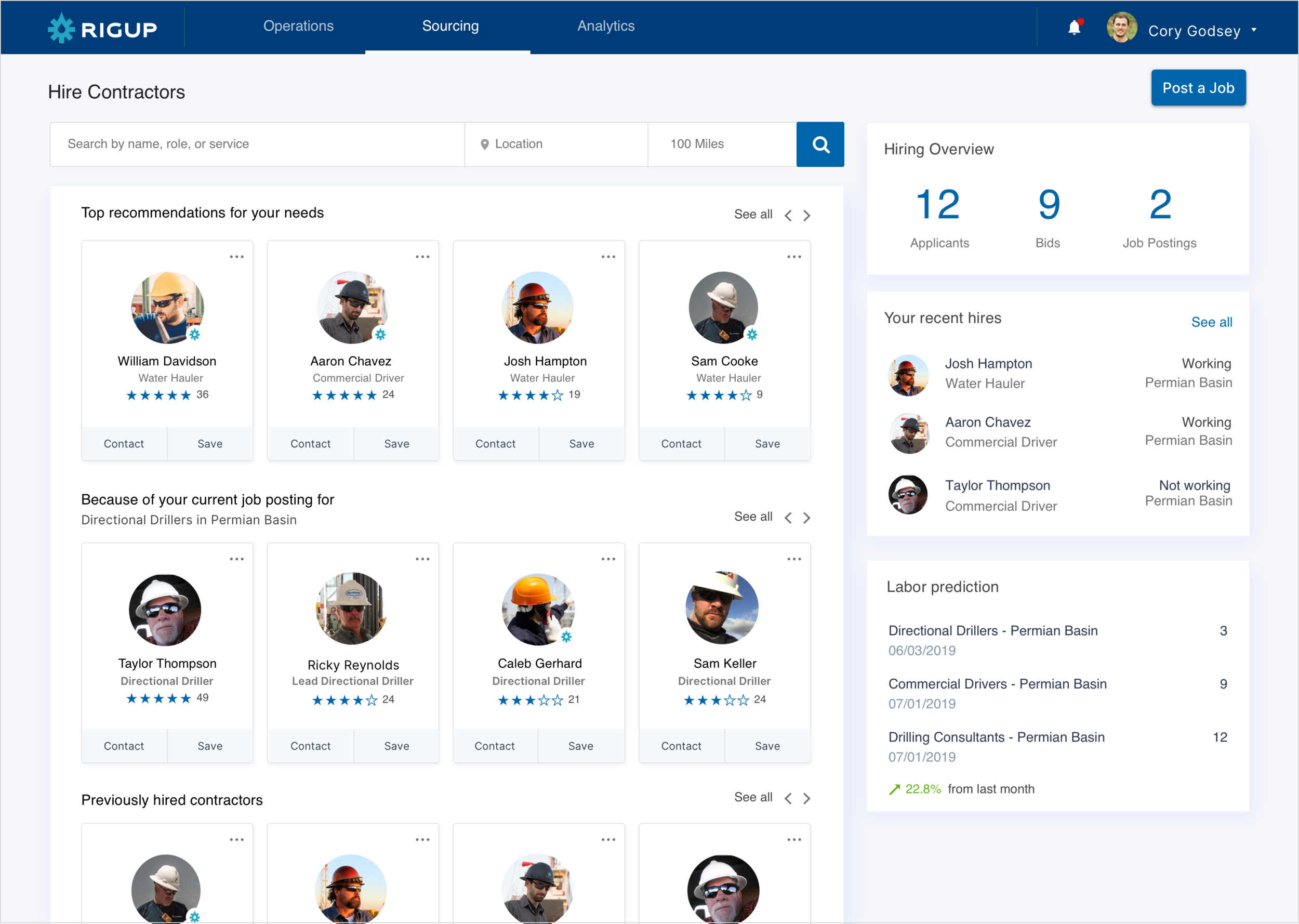
Hiring overview
Cory navigates to the hiring page to submit a request for a new job. He has confidence in the platform because he can see a snapshot of his current job postings.
Quick and easy matching
Finding a better fit
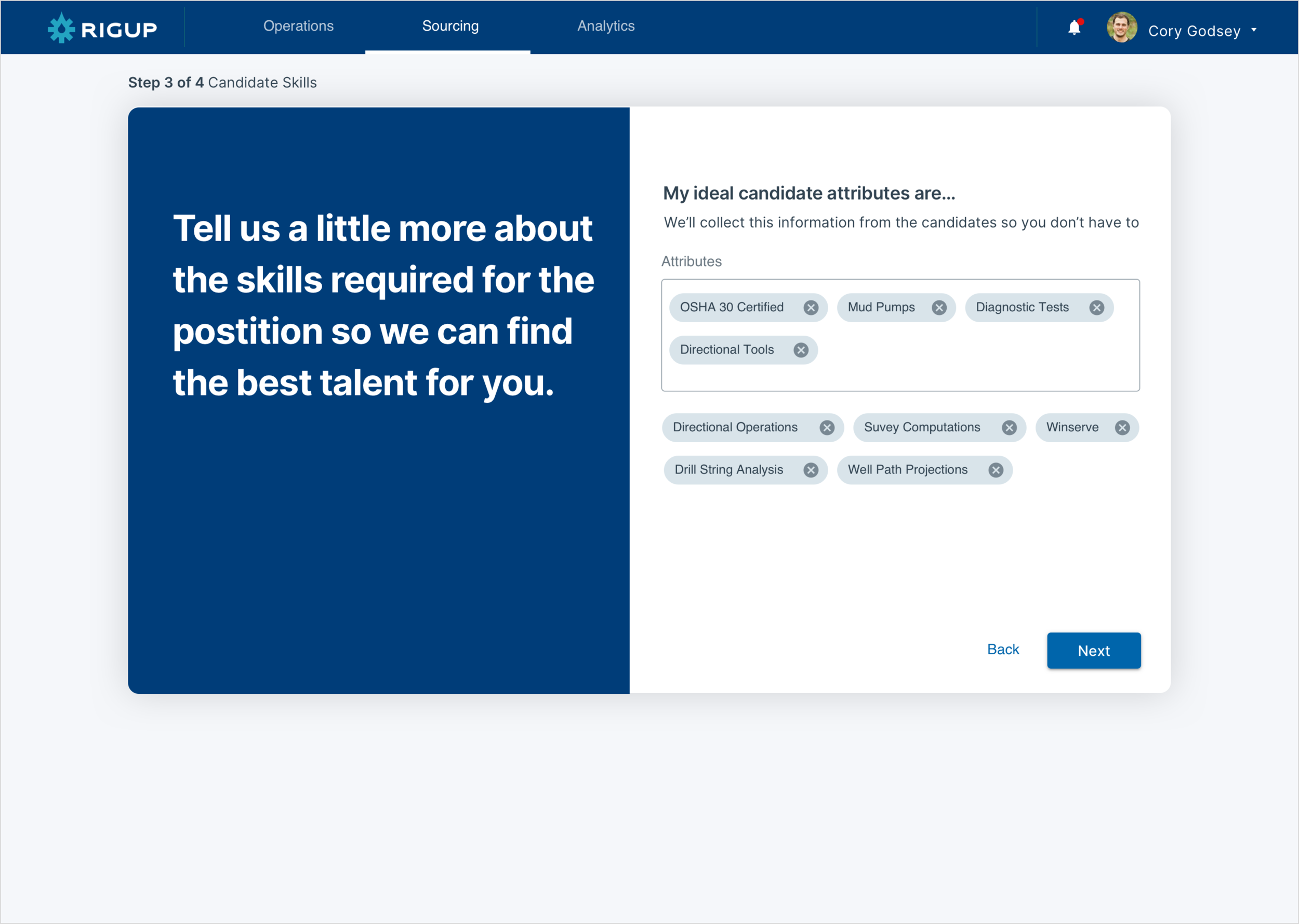
Cory creates a job post for his new opportunity: a Directional Driller in Midland, TX. He enters skillsets within a free-form entry with suggested skill tags based on the role. After submitting the request, RigUp’s algorithm will take the entries and match those to their catalog of skills through the use of machine learning.
Expedited sourcing
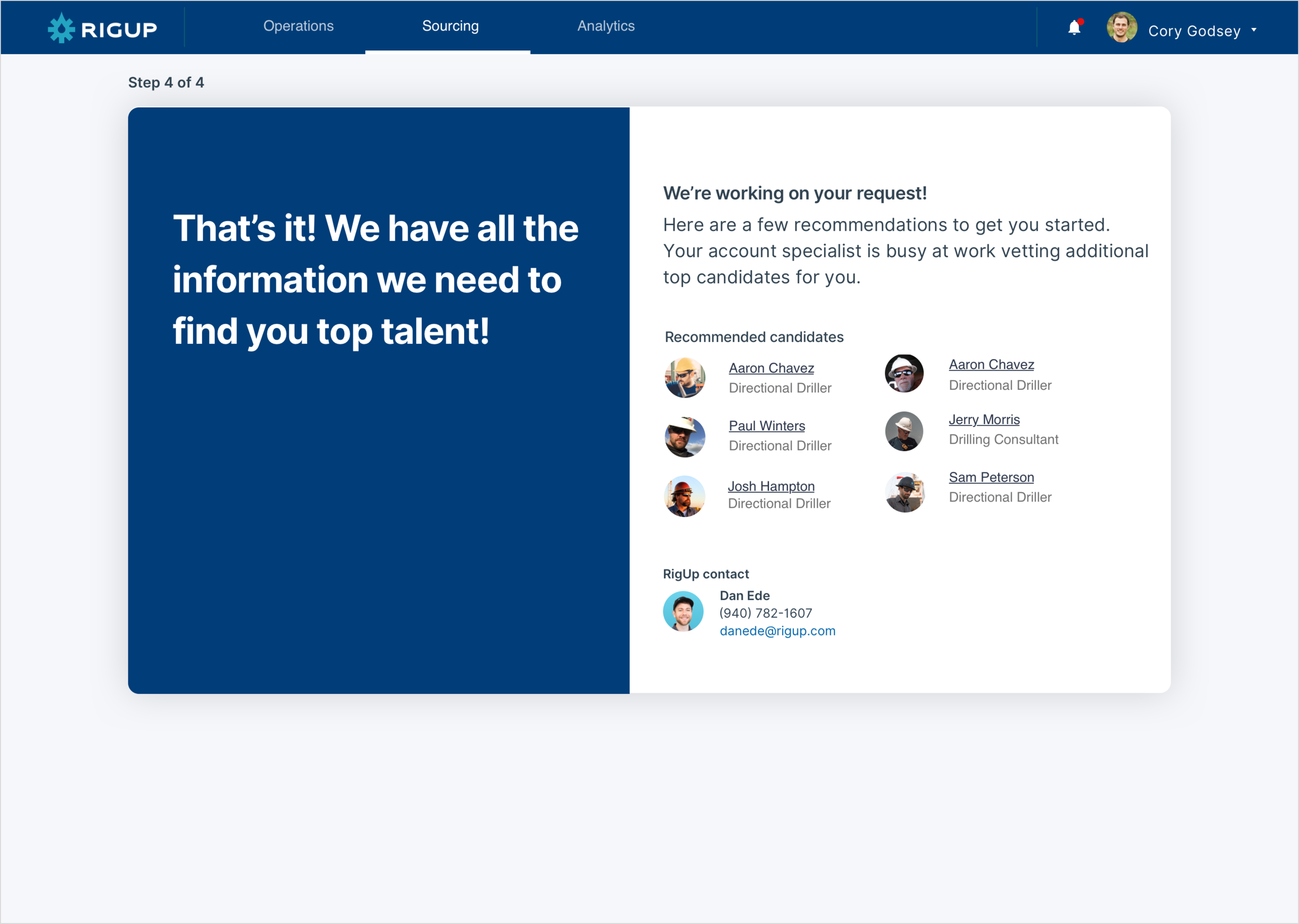
Cory is assigned an account manager that will assist him throughout the hiring process. He immediately sees a list of recommended candidates based on his needs.
Before RigUp, he would rely on staffing firms whose extremely manual and paper-driven processes resulting in significant delays in filling the open roles.
Less work, more results
Contractor sign up
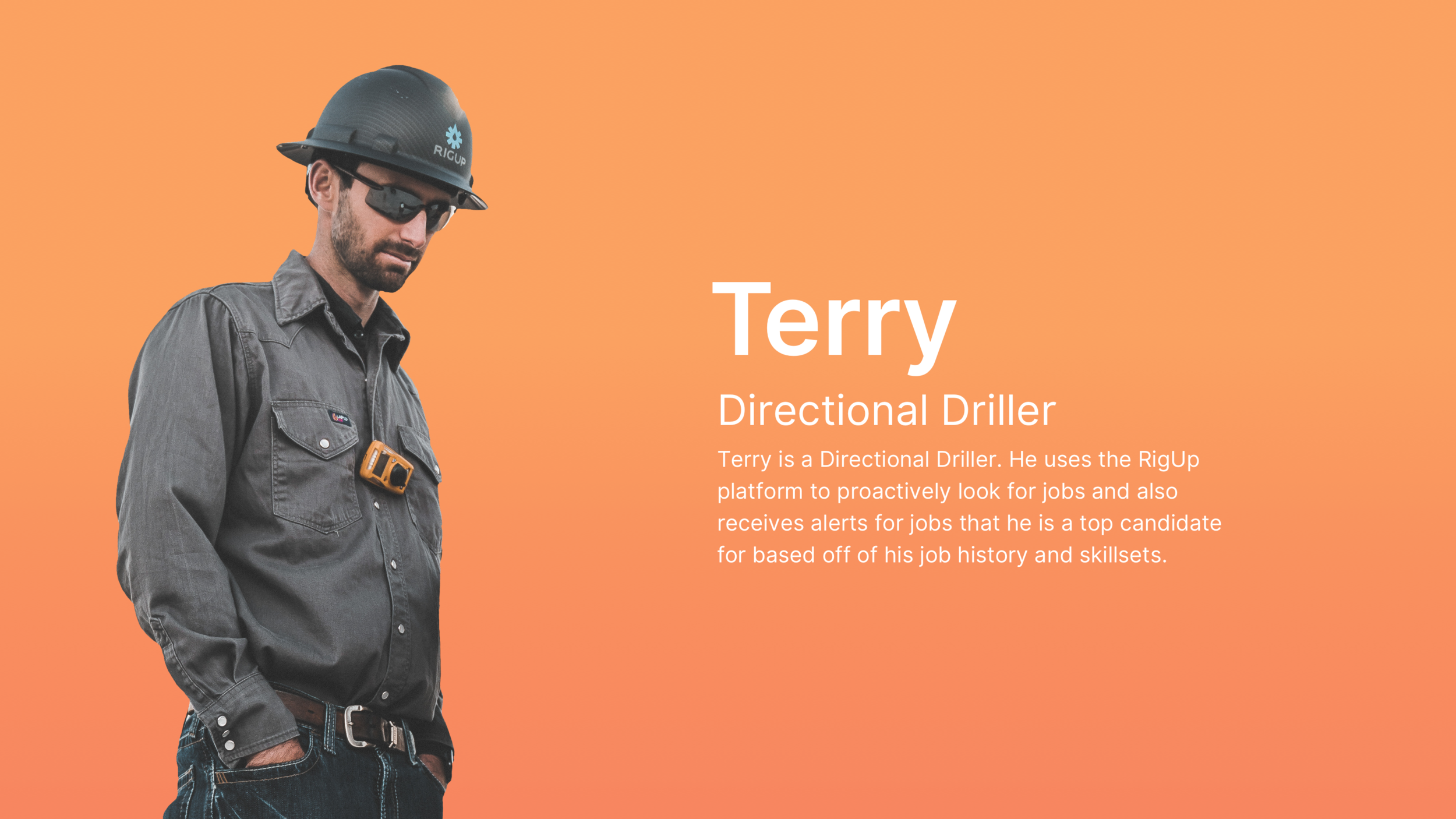
A friend recommends RigUp to Terry as a great way to find work and get paid more than he would with using a traditional staffing firm due to RigUp’s competitively low take rate. He enters a few necessary details and is close to finishing his RigUp profile. The friendly and conversational experience adds a personal touch that Terry is used to with his previous staffing firms.
Less work more results
The contractor onboarding page collects the minimum amount of information needed to match contractors to opportunities effectively; this reduces user abandonment in what was a previously cumbersome process.
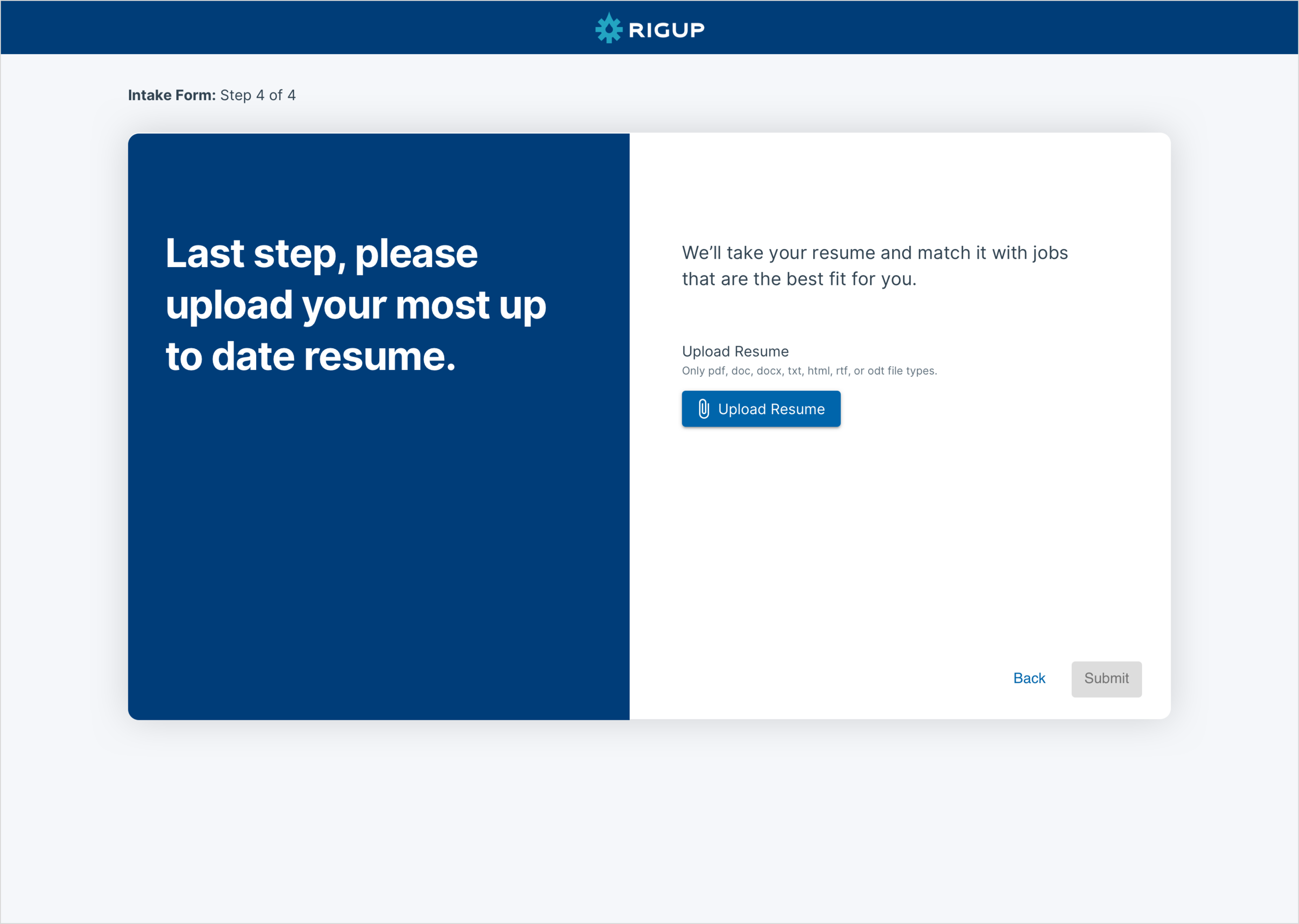
Resume upload
Terry uploads his resume and is finished creating his RigUp profile. Previously he had to manually fill out his work experience and skillsets in addition to uploading his resume. Now, he is automatically recommended for jobs based on his skillsets and experience and he can start proactively searching for jobs.
Automated experience
A third party resume parsing service extracts information from the contractor’s profile. From here, tags are created and matched against the tags associated with our opportunities.
Key problems for Sourcing Operations
Bad Data
The current marketplace data could not be trusted. The Sourcing Operations team was working off of individual shortlists rather than using the RigUp Marketplace. They created the shortlists by manually vetting contractors and storing them on personal Google Sheets.
Off-platform
Since contractor data lived off-platform, we were not able to collect meaningful data. This data is vital to matching contractors with the best opportunities based on their highly specific skillsets and experience.
Manual process
The sourcing process was mostly via phone calls and emails between RigUp Sourcing Operations and Buyers. It resulted in a time-consuming process and a lot of unnecessary and undocumented back and forth efforts between Buyers and the Sourcing Operations team.
Time consuming
Due to the volatile nature of the oil and gas industry, current processes, and a lack of resources, time to fill was extremely long, and significant revenue opportunities were lost.
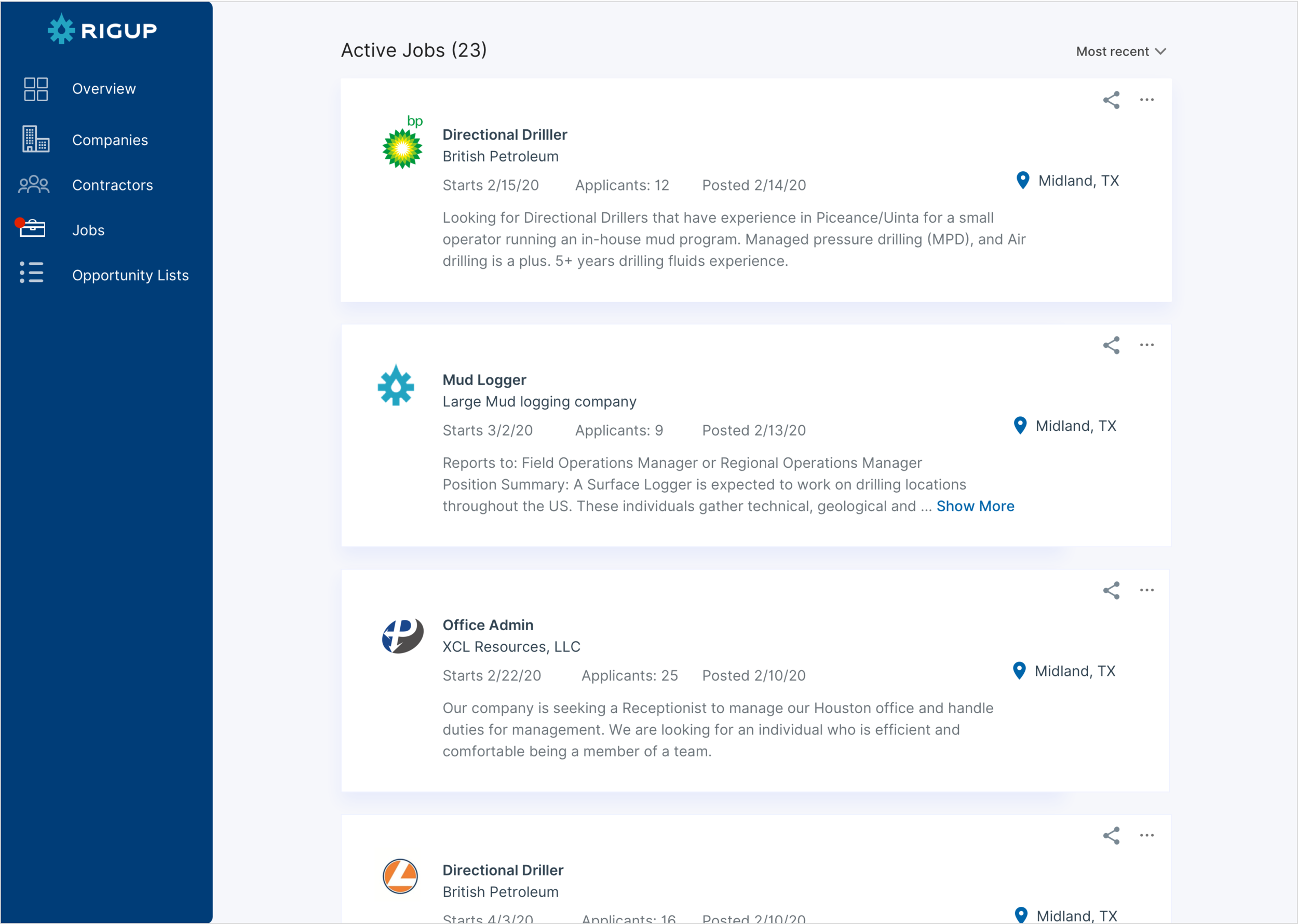
Prioritized opportunities
Job post page
Dan is notified of a new position request, the request that Cory just made.
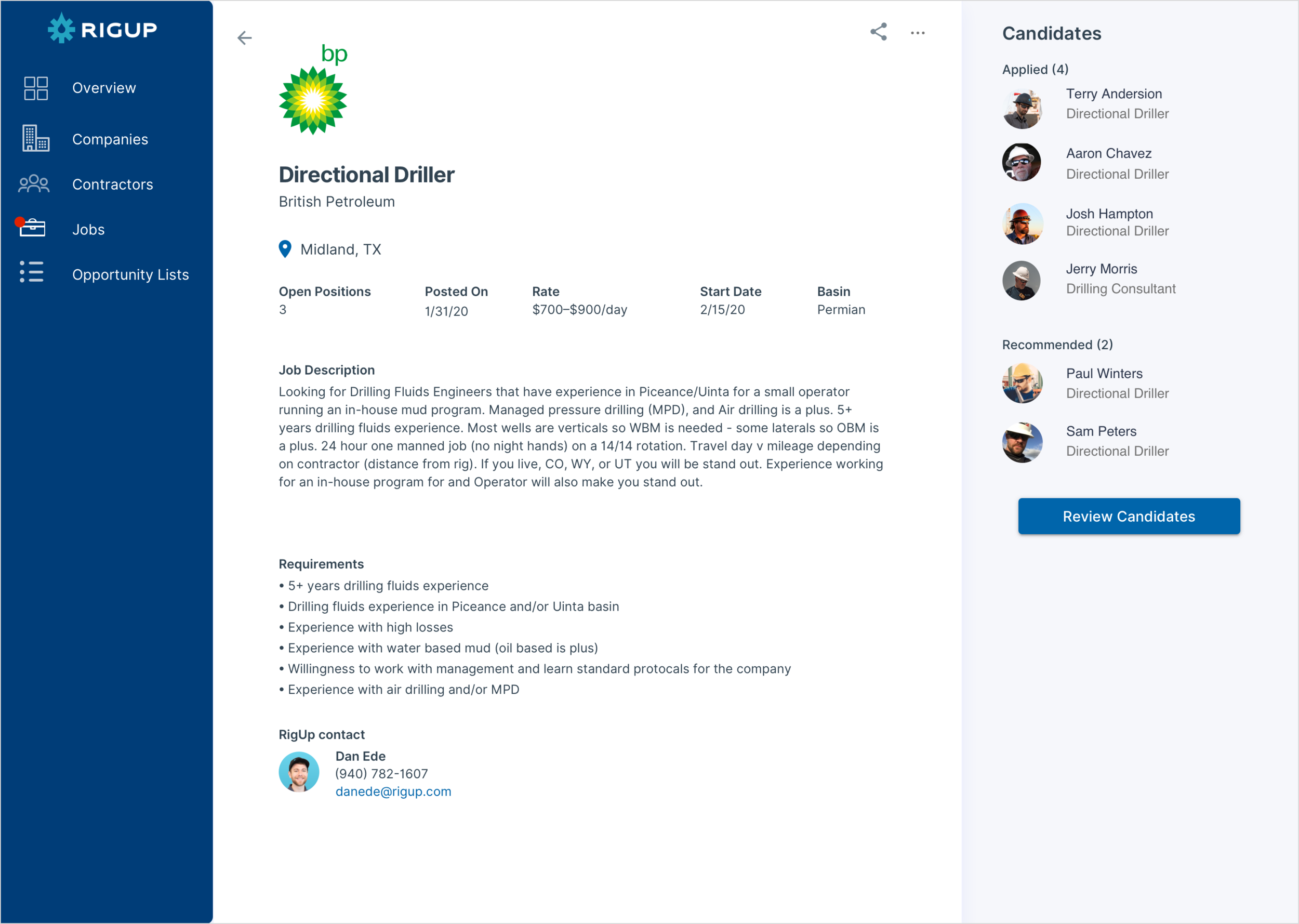
Keeping on top of things
Job post detail page
Dan views the job description and requirements. He can also see a full list of candidates for the job, including those who have applied and recommended candidates.
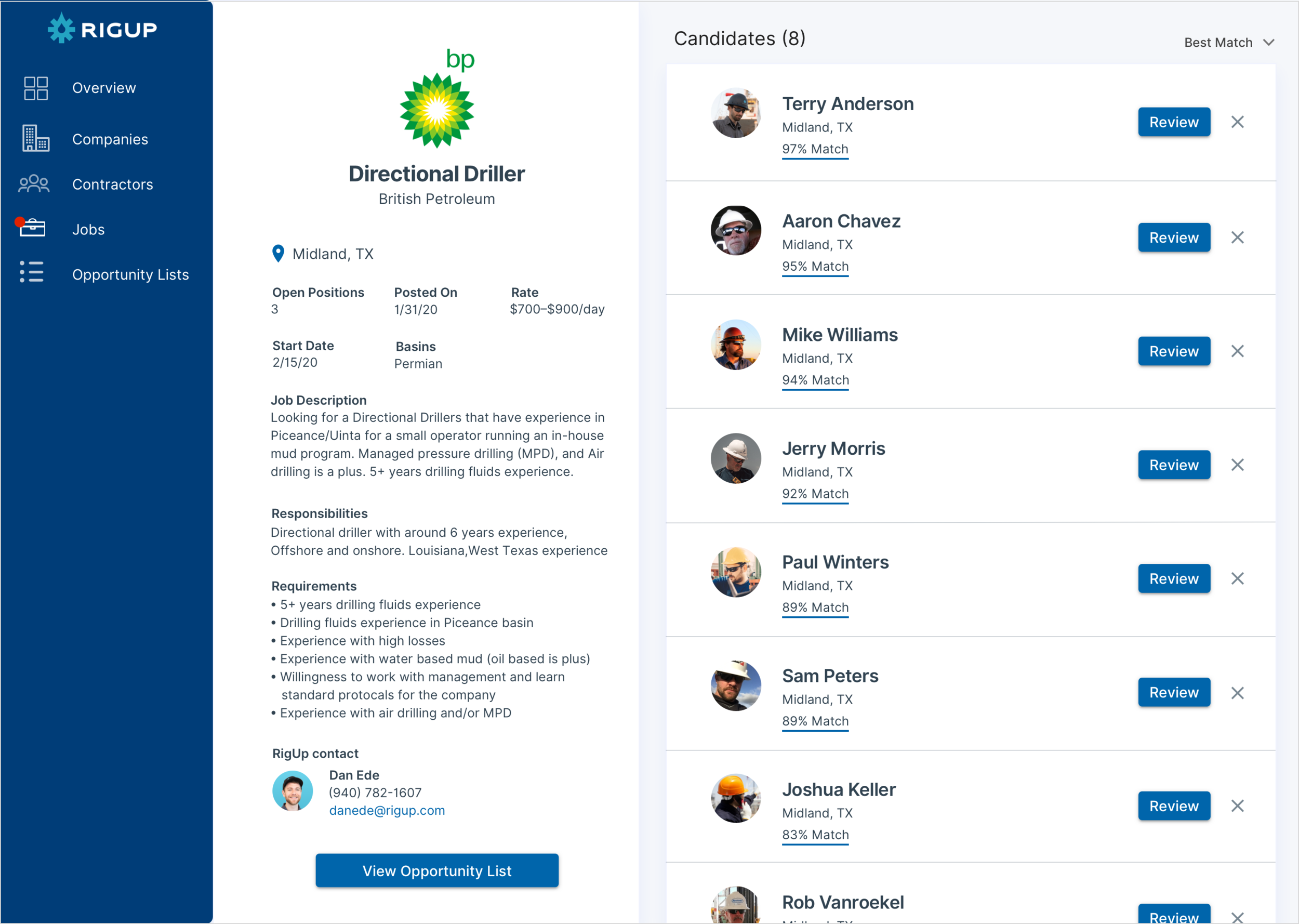
Curated candidates
Candidate approval
Dan reviews the candidates, which includes applicants and recommendations.
A gated experience
Often, there is an overwhelming amount of applicants, and many are of low quality and are not a good match for the position. To ensure the quality and reduce the number of candidates, we created an approval process. The Sourcing Operations team can review a candidate and decide to approve or reject them for the job opportunity. This decision is made easier at an initial pass through by providing the Buyer a match percentage associated with each candidate.
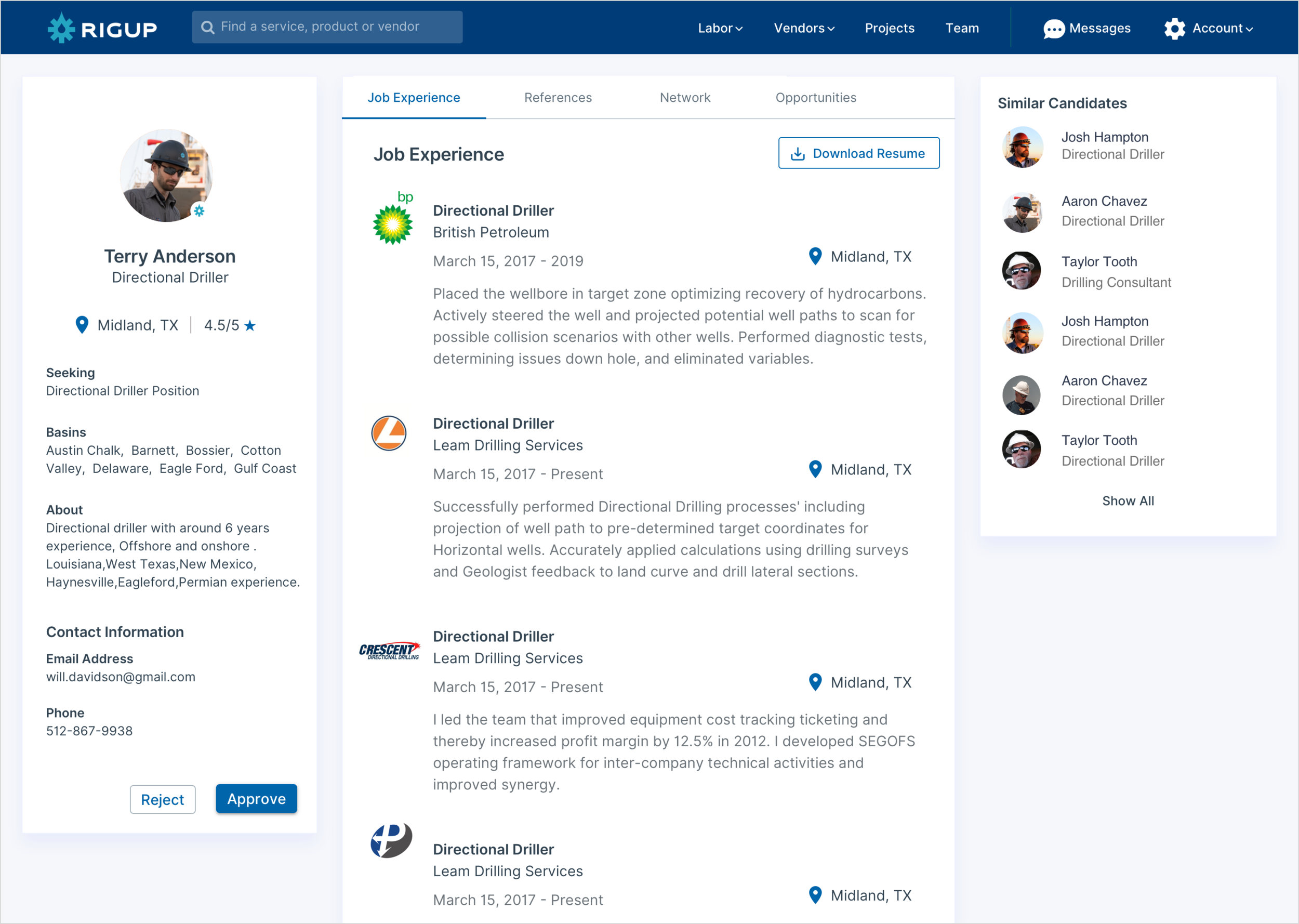
Contractor deep dive
Contractor profile
Dan selects Terry Anderson’s profile to review his job experience, references and decides he is the right fit for the role and approves him.
Source of truth
Previously, there was a lack of trust in the information displayed on the contractor profile since the contractors would not update information. The Sourcing Operations team relies solely on resumes to make recommendations to Buyers due to the outdated information entered in by contractors. Now, the contractor profile is populated from their resume and presented in an on-platform, trustworthy, and digestible form.
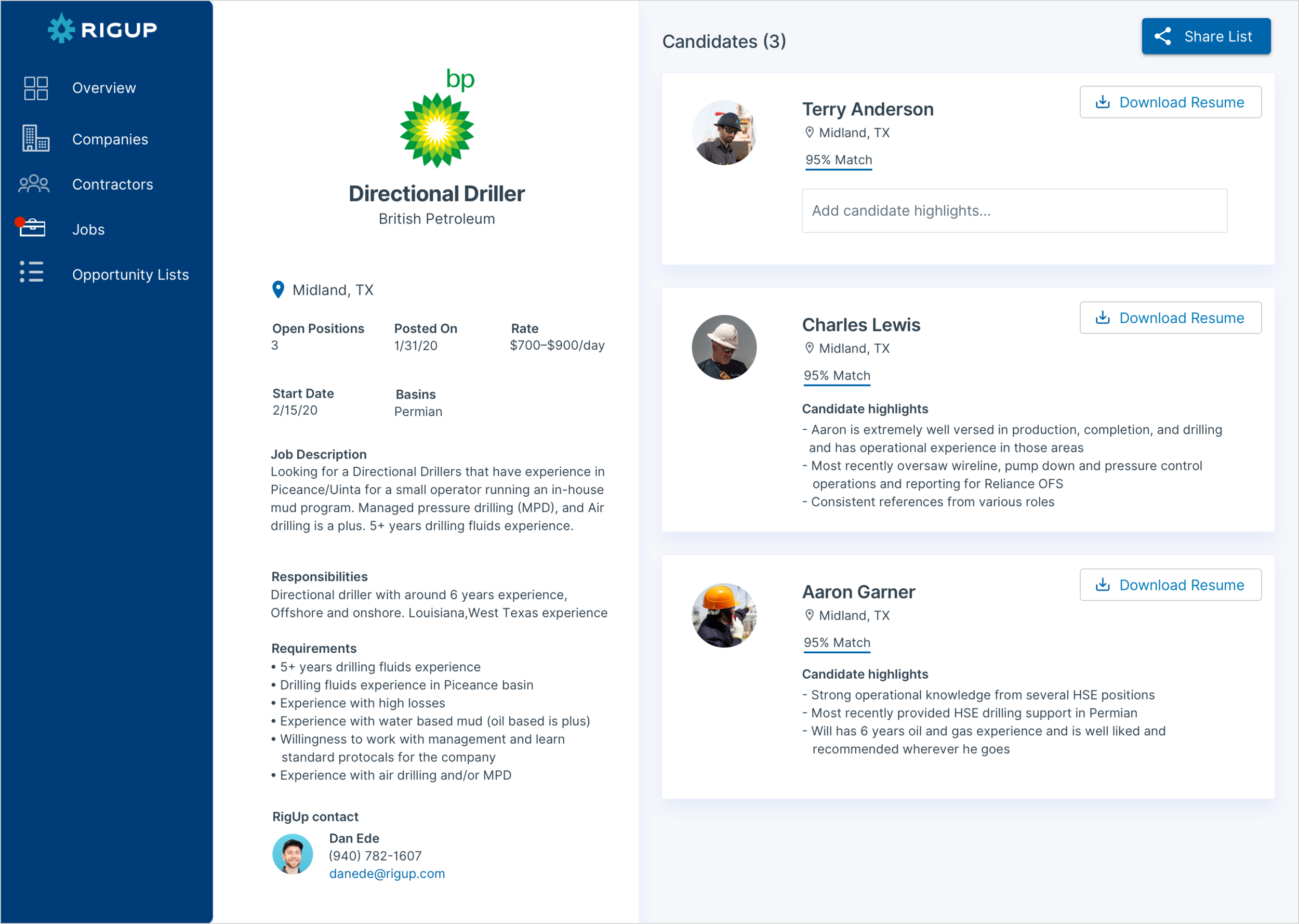
Quality, vetted candidates
Opportunity list
Dan approves Terry, and he is added to his British Petroleum Directional Driller opportunity list. He adds candidate highlights for Terry based on his profile, AI identified skillsets, and phone conversations if necessary.
Vetted candidates
The opportunity list is a shortlist that allows Dan to tailor contractor information to the opportunity and Buyer preferences, adding a human aspect to the sourcing process. This is is important because Buyers are traditionally used to personal communications with staffing firms.
Previously, Sourcing Operations sent an email to the Buyer with a bulleted list of highlights and their resumes attached the did not allow the valuable collection of data.
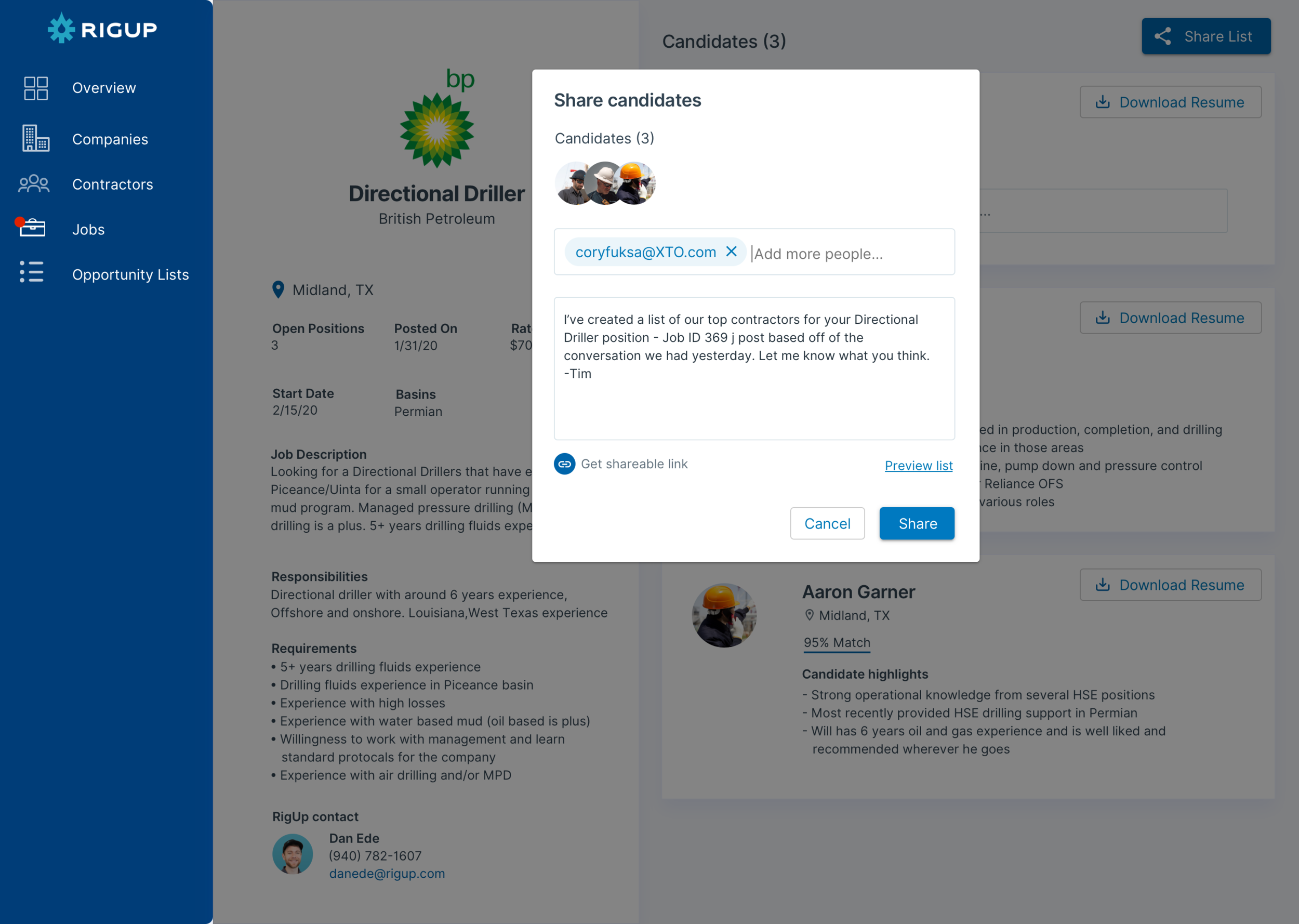
On-platform, shareable candidates
Opportunity list sharing
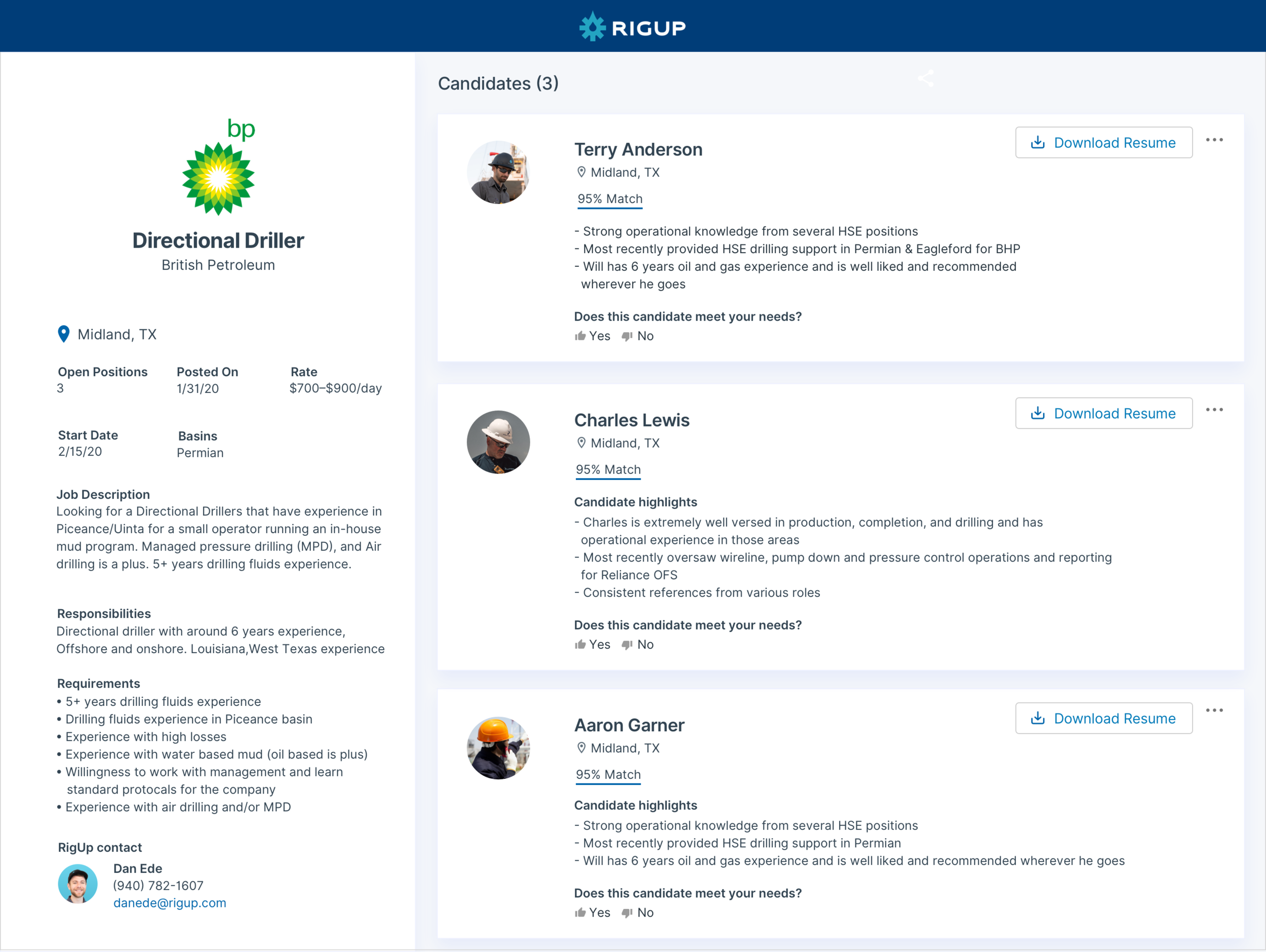
Dan shares the opportunity list with Cory and adds a personal message based on the job details and Cory’s preferences.
Curated and actionable
Opportunity list
Cory receives an email and an on-platform notification that his opportunity list for the Directional Driller job post is ready for review. Cory reviews candidate highlights and profiles to see which candidates are a good match for the position. He decides he wants to move forward with two of the three candidates.
Everything in one place
Buyers expect information at their fingertips in an easily accessible manner. Buyers can access tailored contractor details, full work experience, and resumes from the opportunity list. Instead of wading through emails with attached resumes, Buyers now have an on-platform experience with dedicated account managers.
Feedback loop
Buyers can provide feedback on candidates to improve RigUp’s recommendations in the future.
Measuring success
| Business Goal | Metrics | Success Criteria | Rational | Output |
|---|---|---|---|---|
| Reduce overall time to hire | Days from need to hire | Reduce by 80% | Allow employers to post opening and find talent on-demand | On-platform short list of qualified candidates |
| Qualified candidate recommendations | Percentage hired/contractor placement | Increase by 50% | Value Proposition & Product Differentiator | Skillset algorithm |
| On-platform sourcing operations | Number of applications | Increase by 50% | Reduce operational costs & Collect meaningful customer data | Job board |
| Buyer engagement | Daily Active Users on Platform | Increase to 80% | Corporate Investment to Initiative | Feedback loop for candidates, notifications and alerts |
| ” | Weekly Active Users on platform | Increase to 90% | Corporate Investment to Initiative | " |
| ” | Monthly Active Users on platform | Increase to 100% | Corporate Investment to Initiative | " |
| Automated matching | Instantaneous matching results | On-demand list of candidates | Value Proposition & Product Differentiator | Resume parsing and skillset algorithm matching |
| Buyer Customer Experience | Number of inputs required to post | Reduced steps for employer | Increase NPS score from Clients | Survey and intake form |
| Supplier Customer Experience | Amount of requirements needed | Reduced steps for contractor | Increase NPS score from Applicants | Resume parsing |

Conclusion
What I learned
Having a high-level understanding of the current hiring ecosystem was the key to success. This meant compartmentalizing intended actions to personas and having problems associated with each bucket. The problems needed to be broken down simplistically to have a granular understanding of the actual needs and pain points.
To solve a complex end-to-end problem set for multiple users, I had to work with internal departments and external users. It was vital to have an understanding of current tooling and technical capabilities to create a seamless experience.
What I would do next
There were a lot of areas we still wanted to explore and push further. Throughout our research, we heard over and over that Buyers want to hire contractors that are recommended to them by contractors they already knew. Buyers want to hire contractors that have worked together before and work well together. The next step would be getting referrals from satisfied contractors onto the platform through our current referrals program. From here, we can create a robust contractor network that can be leveraged in the hiring process.
The next thing I would do is propagate forecasted demands and auto-suggest potential needs and relevant talent to fill those needs. This would be driven by daily notifications through email, SMS and on platform to give them a state of the union around the industry.